I remember feeling scared of the sacred indigenous medicines. It wasn’t that long ago that an Ayahuasca trip was a major affair for me. I remember being skeptical in regard to what the sacred medicines could do for me or for other people. You could say that I had no “cultural container” for working with plant, fungi, or animal medicines. I couldn’t really believe in what could be done health-wise or in terms of emotional well-being using these medicines until I was able to think in a more flexible way about them and reconcile my beliefs around this idea that sacred medicines could work with my flesh-and-bones – my body as well as my brain – to produce states of mind and states of being that were full of possibility…possibility that I didn’t have access to in my normal waking state.
I grew up in Nebraska where, as a teenager, I sought out drugs and alcohol in recreational settings primarily to lower my own inhibition and make it easier for me to meet new people. I really enjoyed LSD, for example, because it opened up my consciousness to other realms and other ways of thinking but LSD is not intelligent by itself. LSD creates a situation in which you can dive deeply into your own inner world or share a deep experience with someone else, but it doesn’t slap you on the wrist when you’re behaving poorly in that inner world or try to guide you toward a particular outcome that you’ve laid out for yourself. Nonetheless, just being in the LSD world can be healing in some situations and I acknowledge that. LSD probably saved me from clinical depression and states of mania to which I often succumbed during my university days.
In contrast to LSD, magic mushrooms are intelligent and also very wise. Ayahuasca is also intelligent and wise. For me the idea of submitting to the spirit of the magic mushrooms or to the spirit of Ayahuasca was terrifying, at least in part because I feared losing control over myself as a result of interacting with these wise medicines. Instead of feeling like I would be guided and even coddled by these sacred medicines, I imagined that I would be punished or toyed with mercilessly. Most of all, I feared self-confrontation in the presence of a plant-consciousness that initially felt really foreign to me. At that time, it was hard for me to draw a perimeter around the fear because at that time, I could only really label it as a Fear of the Unknown. Again, I had no cultural container and thus no vocabulary to even discuss the fears that I had. I had plenty of fearmongering from other people in my community about sacred medicines like Ayahuasca and with very little (if any) encouragement to give me faith in these medicines. At best, the people I grew up around who raised me, my role models,knew nothing about the sacred medicines at all.
The fears around working with the sacred indigenous medicines are similar for everyone who comes from the developed world. A fair number of people are afraid that when they go into a trip the first few times, they’ll confront themselves as a horrific monster. Other people are terrified of losing touch with their beliefs and values. Perhaps the sacred medicines are evil and they’ll be guided away from what’s good into the pit of hell. What if a mushroom trip changes your mind about something that’s central to your belief system? Still other people are afraid that they’ll lose their minds and be unable to regain a foothold in consensus reality.
Usually, the “monster” that people are afraid to confront is actually an Inner Child who was injured terribly by a trauma from childhood which turns out to be not-so-scary as long as the person tripping has compassion for this part of themselves. For me, the experience of having compassion was like taking a tour of very specific memories and bits of information about my past and my family member’s pasts. When confronting my inner “monsters” (read: children), I often found that a lack of compassion toward others led to a lack of compassion toward myself. But the mushrooms were always diligent in making sure that I could maintain safe boundaries despite having compassion for parents, grandparents, siblings, etc. These are complicated emotional maneuvers which is why something like Eye Movement Desensitization and Reprocessing / EMDR and craniosacral therapy, though valuable as trauma-informed medicines, will never be able to match what the sacred medicines can do for a person. After more than a decade of working with the sacred medicines intensively, I have faith in them now. I have watched people who profess to want to change something resist change with every fiber of their being, vomiting into the void rather than weeping as a result of self-compassion. You can resist the sacred medicines if your true intention is to avoid the message that they’re trying to convey to you.
For many people, the initial work that they do with the sacred medicines is a show of resistance and push-back. The first thing that most people encounter on a trip is their own defenses throwing punches in the air. Those who really wish to overcome something, keep going past this resistance until something fruitful manifests on a trip. Those who think that strength is in resistance and their own defense against the self don’t get past those initial few trips.
The idea that we might be able to know or imagine what we’ll encounter on a mushroom trip or an Ayahuasca trip is something everyone confronts pre-trip. Everyone tries to think about and logically come up with a map for a trip with the sacred medicines. But every mushroom trip is different from the ones that came before it. Ayahuasca is the same way. Though some of the landscape features are similar from trip to trip, some parts of the trajectory get easier to comprehend, and while finding the right gets easier and easier too, the only thing that’s always true is the fact that every trip is different.
But slowly, over time, we get better and better at confronting The Unknown. The Edge is similar to The Unknown except when we refer to The Edge, we’re specifically talking about the unknowns that hold the key to solving our problems.
What is The Edge?
When I talk about The Edge, I’m not talking about the problem of going “off the edge” or of losing touch with the central fabric of who you are while working with the sacred medicines. Rather, The Edge is the outer limits of what you believe. If you could draw a circle around the outer limits of your beliefs,The Edge would be the line between what you believe and everything that exists beyond those beliefs that you don’t yet know about yet. Whenever a person is trying to solve a major health issue, a life quality issue, relationship issues, or mental health issues, they hit up against The Edge as a self-imposed limitation in terms of what’s impossible, what’s improbable, and the possible ways in which an issue of any kind could be resolved.
I grew up in a very Christian, fundamentalist home. My dad was Catholic and my mom was Lutheran. That meant, essentially, that I was Catholic and Lutheran (the two require some acrobatics to mix fluently). I fell into the “Bible-beater” category of fandom in terms of Jesus for a long time and though I was always academically captivated by things like serial killers, criminal behaviors, sexual issues and dysfunctions as well as aberrant sexual behavior, drugs, addiction, and cultural divergence, I tried earnestly to make my pursuit and academic interest in regard to darkness into something the I was doing to serve The Light.
For me, there was a point when John and I had a stillborn baby early in our marriage, where I became unstuck from my beliefs out of necessity. After the stillbirth, I became more flexible and much more open to other ways of viewing things because I had to in order to survive this loss. This was an event that gave me great pause in the grand scheme of things. The church said that we’d sinned and this was why our baby died. The Lutheran church also says that unbaptized babies go to hell. Unfortunately, the pastor of our church came to our house and reminded us of this fact verbally as we were picking out the gravesite. That was a devastating day that totally leveled me emotionally within the landscape of what I had been taught since childhood. So my belief system and my Edge had to move outward beyond what I’d been taught and beyond what people were telling John and me about our level of fault and the meaning behind the loss of our child. My Edge had to expand or John and I would’ve died from the pain of this experience.
At the time, of course, losing our baby, being told that the baby would suffer for an eternity, and being spurned by the church was horrific. But I look back at the experience now and how that first big wound that we suffered was important for us in favor of expanding our Edge. At this stage in my life, I can say that I’m grateful for it. I’m grateful to the soul that signed up to be my second biological child and for the role that he played in spurring growth for me and John.
What would we have done without that baby that died? O
Am I allowed to be grateful for something as tragic as losing a child? Of course! But no one in my culture-of-origin gave me permission to be grateful or okay with losing a child. Culturally, I should be a mess for the rest of my life. But because my Edge expanded twenty years ago in order to accommodate the loss of an infant child, I was blessed with other opportunities and ways of looking at the world that weren’t available to me back then.
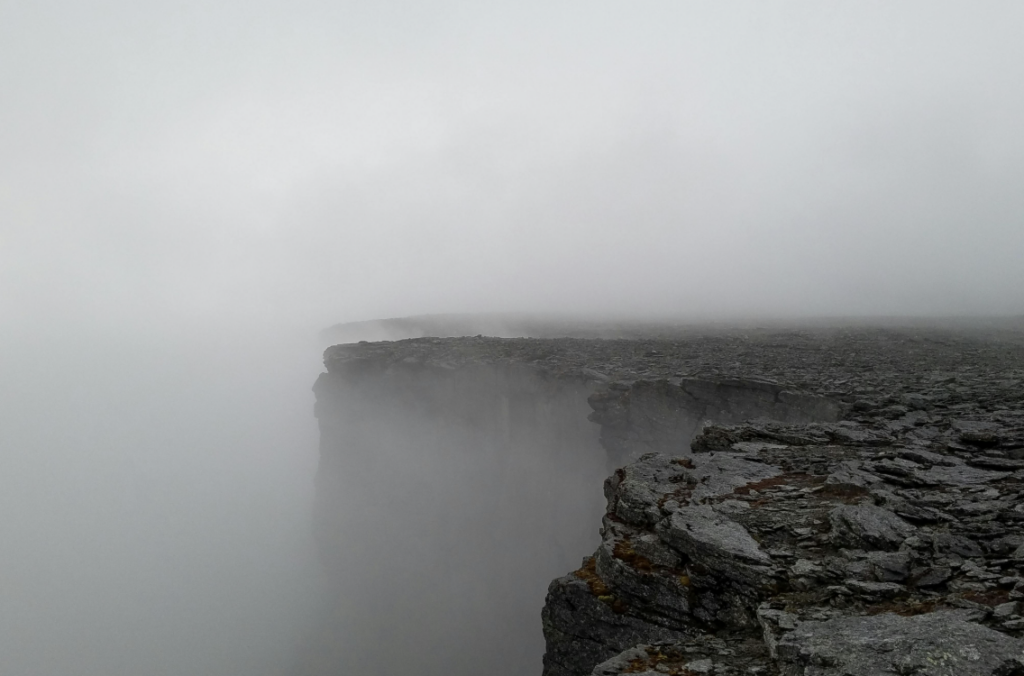
The Edge is a bit like a cliff that drops off into nothingness – The Unknown – wherever you get to the limit of what you know and what you currently believe through experience or book-learning. Beyond The Edge, you might believe that nothing exists or that only evil things exist. How you orient yourself toward evil though, can itself create evil, in my experience. If I’m deathly afraid of demons, for example, my fear makes me vulnerable to these dark entities. So I think of demons as though they’re little children who have been rejected by whatever or whoever might have loved them. They’re demons in part because they don’t know about love. I was taught to be afraid of demons without exception when I was a child and I still believe that demons exist, but I’ve come to a slightly different understanding of their size and their fear-factor. If demons are the size of children, they might still be able to throw terrifying temper tantrums, but I’m still the adult. I’m bigger. But I didn’t arrive at these thoughts about demons all by myself. I had some guidance from the mushrooms and Ayahuasca, Sapito, and San Pedro to expand my thinking on this topic.
Basically, fear begets fear. Sadness begets more sadness. Anger begets more anger.
The Edge is like everything that you know and that you believe is an island bordered by these cliffs that drop off into a Sea of the Unknown. You might have spent your whole life searching the island where you live to find something to solve your problem. Using the logic of everyday consciousness, you naturally avoid the cliffs and the steep drop-offs. The Sea of the Unknown might seem impenetrable and terrifying. But it also contains the solutions to all of the problems on your island that seem unsolvable. Out in the Sea of the Unknown are undiscovered islands, plants, animals, and major, life-changing discoveries that you can’t imagine until you learn how to fly and how to swim. There are some scary things out there, that’s true. But if your pain is greater than your fear, you might still decide to jump off or jump in and set sail for distant lands.
Curiosity vs. Conquest
There have been times in history when people have had to literally set sail for new worlds in order to solve major problems in their home country. Hernan Cortes comes to mind as the man in charge of the Mexican Conquest, for example. Cortes came to Mexico in search of things that were considered valuable to Spain. So Cortes had an Edge that was predefined and fairly limited when he set out toward Mexico and when he arrived here, gold was the only thing he really cared about. He was trying to impress the king and the queen. He had a very specific mission and his goal was to accomplish that mission without deviating from his plan.
I think we can all agree that the results of Cortes’ conquest would’ve been completely different if he had set out with curiosity to simply observe, experience, and document what was “out there” rather than to conquest Mexico and Latin America. But on earth, we often approach life and reality as a thing that needs to be conquested rather than as something about which to be curious. Curiosity leads to a different result than conquest, after all.
Like Cortes, in our lives, we sometimes have to metaphorically set sail for distant lands in order to solve problems for which we lack either internal or external resources. Even the most devout Christians and Buddhists, Muslims, and atheists sometimes end up at the Edge of their own inner cliff, staring off into the abyss as the only source of hope. Some people recoil from the cliff’s edge and deny that the abyss exists. That’s just one way of dealing with the abyss, but it’s not my favorite way. Sometimes people will judge another person harshly in regard to their Edge and how that person chooses to deal with the abyss beyond it. When a community of people really supports denial of The Edge, anyone who’s forced to stare into the abyss might think themselves bad or evil. But the main thing to remember is that if you have to use anger or the desire for power to motivate yourself to set sail, you’ll be blind to anything that doesn’t look the way that you expected for it to look when you arrive at a novel location. Curiosity is a better way to truly expand your Edge if you’re setting sail in order to find the solution to a problem that seems unsolvable according to all that you know and believe on your original island.
The Answer to the Problem Is In the Sea of the Unknown
The lands in the western hemisphere are not inherently evil. The oceans of the world are not inherently evil. Yet, despite the actual need for ocean exploration and the discovery of the continents of the planet, we’re taught to avoid discovery and The Unknown as though it were bad and wrong. We need The Unknown to solve problems and to look at things in new ways. If you work to learn everything that’s known about cancer in order to try to cure cancer, and then you hit your Edge, it’s time for you to explore beyond what you know and beyond what your community knows. A community could be a nation or it could be just a corporation. Whatever represents a social factor in your life that limits you to produce an artificial Edge of disillusionment and false safety acts to prevent you from going into The Unknown to explore. While most of the time, that social limit makes you feel safe, there are times when you need to go beyond what your community says to do. There are times when playing it safe can actually produce the greatest harm.
If you’re searching for the cure for a disease for a person who is very sick and you can either stay safe and avoid exploration beyond The Edge or you can set sail into the Sea of the Unknown, your beliefs will either work for you or against you in making the decision. If you believe that there’s a cure for every disease or that any problem that you wish to fix is fixable and that the desire to cure diseases and fix problems is what fuels our constant progress forward, then your courage will certainly be stoked. On the other hand, if you believe that the Sea of the Unknown and The Edge are inherently evil and that diseases and life problems are a punishment from God or a token of suffering (and if you feel pride about your own suffering), you might lose your courage and be unable to move forward. The safer bet might seem to be about turning away from the abyss and the Sea of the Unknown to satisfy the needs of the community to stay the same and to not have to grow and change.
But if you believe that the cure for a major disease exists and if you’ve done a lot of exploration in terms of what’s known within your culture or community without success at finding a cure, you can then surmise that the cure must be something that you’d be able to find only in the Sea of the Unknown beyond The Edge of the cliff where your own knowledge-base and belief-island drops off. If you really believe that a cure exists, but you cannot find it within the Known, then you can assume that this cure can be found within The Unknown.
Pushing Your Edge
The sacred indigenous medicines take us as we are. They work with us according to our beliefs that we already have and the knowledge that we’ve managed to acquire at the time when we work with them. But on an Ayahuasca trip, or on a psilocybin trip (or Sapito, San Pedro, etc.), the sacred medicines push up against the edge of what we believe and what we know in order to expand this Edge. The Sea of the Unknown becomes navigable when we submit and stop resisting and fighting against a Wisdom that’s much bigger than our own wisdom. Indeed, the outer perimeter, The Edge of land and the borders of cliffs expand outward into the abyss.
Clients are often hasty to proclaim to us (without ever having taken a sacred medicine in any form) that the sacred medicines involve God speaking to us. This is one way of looking at it, but it’s extremely reductive. Nonetheless, it’s a fine model for the sacred medicines if it helps a person make peace with them so as to make use of these miraculous healers. To say that Ayahuasca’s voice is God’s voice is a bit like putting training wheels on a thought-cycle. Why can’t Ayahuasca be an individual that was perhaps created by God in order to help humanity? What really determines whether or not you can find your way to the cure for a disease, mental health issue, addiction, etc. that other people say is incurable and insurmountable, has to do with what you’re willing to confront inside of yourself. Are you willing to know good and evil for yourself without the judgment of other people telling you what’s right and what’s wrong for you? Are you willing to trade your conformity within the culture you were raised in to find the solution to your problem or the cure for a disease? If not, then this becomes a non-negotiable Edge for you. It’s a boundary and the sacred medicines won’t broach that boundary if you really prefer the safety of your beliefs instead. If you would rather belong to your culture with all of its potentially toxic thoughts and limiting beliefs rather than solve your problem then that’s what the sacred medicines will give you. If you would rather sit in a place of worship and be revered as “good” by the other human beings who are there rather than seeing the magic of this earth that the Creator created, that’s entirely your choice. Most people actually decide that they would prefer to be popular or to maintain their social position rather than save their child’s life or their own life.
On a psilocybin trip, I might be able to navigate out into the Sea of the Unknown and make a major journey with a map that’s offered to me by the mushrooms, plant medicines, or venoms. LSD doesn’t offer a map like that. Neither does ketamine. But rather than being totally alone in The Sea of the Unknown, we get to push our Edge with Grandmother Ayahuasca to guide us or with the magic mushrooms lighting the way. Everything that you believed before you set sail will remain with you, but your beliefs and the island that you inhabit in your mind will get bigger if you’re willing to allow your beliefs to expand. This requires actual faith that is actionable and powerful. I’m not talking about faith as a blind belief in something that you’ve never seen to sing songs or recite creeds or sutras, but rather faith that involves placing your mind and your body into the trust of the sacred medicines to show you what you need to know in order to produce a healing response.
This is not an entirely unfamiliar process to most people. What you believe when you’re 4 years old is based almost entirely on what your parents / guardians told you to believe. By age 12, you begin to question those beliefs and their ability to guide you through the upcoming period of uncertainty (puberty and young adulthood). Chances are, by age 16, you’re challenging some of your 4-year-old beliefs in an active way. Your parents / guardians might loathe your methods or be terrified about your experiments in terms of belief at this age. Around the time when you find a mate, have a child, or find a profession that settles you down, you might re-explore some of those important, original 4-year-old beliefs. At this time, your understanding and your way of interpreting those beliefs might be radically different and more mature than those 4 year old beliefs. Or they might be somewhat unchanged since age 4. But certainly, hopefully, a married woman will understand and appreciate Jesus differently than a 4 year old child, after all, even though the fundamental beliefs might remain very similar to those of a child. How beliefs are interpreted can be challenged by mushrooms or Ayahuasca especially if your interpretation of your beliefs are toxic and harmful to you, but generally, the beliefs themselves don’t change that much. Beliefs tend to stay in place when people work with the sacred medicines, but we expand the beliefs to produce a structure that is less rigid and more flexible in the winds of life.
For example, I have not abandoned my original Christian beliefs that I had when I was 4 years old. I have, however, absorbed quite a lot of new beliefs that don’t threaten those original beliefs, but that rather connect into them in elegant and sometimes surprising ways. My vocabulary regarding my beliefs and the concepts that I use to speak with clients about belief in general allows me to move around within a very intricate and detailed belief system. I enjoy hearing about what other people believe because it sometimes helps inform my own model of the Universe. When I was younger, I used roads and highways to move around within the material that made up my beliefs. Now those beliefs are embedded within a system that includes medicine and healing as well as historical connections between Christianity (also Buddhism, as it turns out, through my son-in-law) and sacred mushrooms like psilocybin mushrooms and Amanita muscaria. I use a drone instead of clunky roads and highways to get from point A to point B within the material that makes up my current beliefs.
Some people who are reading this might be put off by my Christian origins or my willingness to learn a bit about Buddhism through my son-in-law. Some people might be reassured by my openness. But as far as the sacred medicines are concerned, I’m not the one who dictates or reinforces a client’s beliefs. Beliefs are pretty solid, but our interpretation of those beliefs can change pretty radically as we grow and mature. Sometimes beliefs that we hold within one area of our lives are connected in surprising ways with beliefs that we already hold in other areas of our lives. In other words, on a mushroom trip, or through Ayahausca, we influence ourselves. We stop being hypo-critical and a bit blind in regard to the beliefs we hold in one area of our lives and another contradictory belief that exists in another area of our lives. Both beliefs may be a resource to you, but they aren’t accessible at the same time which creates limits. Connecting beliefs like this together can be truly life-changing. Sometimes, when you connect your work-related beliefs with church or temple-related beliefs, the answer to your question or the solution to your problem emerges out of something that is familiar, if not entirely mundane.
Often, when clients work with us face-to-face, they fear that we’re going to try to indoctrinate or evangelize a particular perspective in terms of spirituality in particular. But beliefs are quite rigid and it’s important for clients to recognize within themselves that they can stand on a belief as though the belief was a solid rock. Indoctrination only works during childhood when people lack what’s known as the “critical factor”. The “critical factor” might also be referred to as the “bullshit-o-meter”. It’s the part of us that emerges around puberty to evaluate adults and what they’re telling us to think and believe. Once you’re an adult, the critical factor stands guard to make sure that your beliefs can’t be modified without significant consideration. On the other hand though, indoctrination can be modified especially if you’ve been indoctrinated to profess certain beliefs that you don’t really feel. Then the so-called belief / indoctrination might be something that you reconsider on a trip. If you’ve been indoctrinated with something that doesn’t feel solid like a rock, the indoctrination will need review because it might be preventing you from moving forward toward healing.
Our beliefs don’t generally need babysitting. Beliefs are solid and they aren’t easily changed. Indoctrination needs babysitting though and constant repetition or else it starts to dissolve. The human beings of old had to figure out every single thing that we regard now as Known, but these animal-like human ancestors sorted through Known and Unknown using tools like magic mushrooms before book-learning was even possible. Before language, there was no indoctrination. These old-humans were brave explorers who had no history books to consult and only their inner reality to guide them in the external reality. You might believe that God spoke directly to these early humans and basically, I would agree, though I might use slightly different words to describe what was happening. In any case, your beliefs are made up of something that’s surprisingly resilient to meddling by others. Indoctrination is rather fluid though. So just be aware of that and consider it if you’re concerned about beliefs that might change on a mushroom trip. Humans evolved to have the luxury of indoctrination to prevent us, as a population and as a culture, from feeling pain, particularly in certain social situations. There are rules like, “Don’t kill,” for example, that most humans believe in quite strongly. This rule is indoctrinated and preached in the major religions because it serves the general public and reduces emotional pain that could happen within the group as a result of a murder. Yet, while an individual might believe “Don’t kill,” is a good rule, they will praise the soldier who goes to foreign lands as a person who is “serving the country”. We thank the soldier for their service, knowing that their service involves killing and hurting others. Many of these same people who profess that “Don’t kill,” is a hard-and-fast rule would kill an intruder in their home if said intruder threatened their children or loved ones. So the belief that killing is bad is only correct in some situations. It’s not exactly a belief. We profess to believe that not-killing is good and that killing is bad, but we also believe that there are contexts when killing is okay or warranted. As such, “Don’t kill” is indoctrination. This is just one example of a contradiction in terms of indoctrination (as differentiated from belief) from one area of life to another. The actual belief might be something closer to the idea that “Murder causes pain”. The first humans on earth had to learn that to kill someone else can be incredibly painful for the killer and for those who knew the person who got killed. So this rule about killing evolved into a form of indoctrination that still exists today unchanged. It is indoctrination that we only apply in situations outside of war or in situations that threaten our own lives. For soldiers who come home from war, the indoctrination that killing is bad and that not-killing is good can be triggering and painful if it is not thoroughly reviewed and reworked internally into a tolerable and sensical belief that can be restated in a way that does not produce self-judgment in daily life.
As you read this, you might be offended. Or perhaps you feel very comfortable and familiar with these ideas. In any case, if you’re exploring the use of Ayahuasca or magic mushrooms for trauma, a feeling of being offended by the idea that some of your beliefs might directly contradict other beliefs that you hold dear is the front-line for you. Feeling offended means that at least one part of you feels upset toward another part of you that’s reading this material. The part that’s offended wants to maintain the indoctrination. The part that keeps reading wants to rework it. In my experience, contradictory beliefs can be resolved and reconciled, but only if the person who has the contradictory beliefs is willing to confront this problem with curiosity, faith, and submission to the sacred medicines. The Core Self has to step forward on behalf of the Internal Family System that exists inside each of us to navigate these kinds of internal conflicts.
Beliefs are important and valuable because they help us understand the world and everything in it through a lens that prevents us from being totally inundated with data. But beliefs can also prevent us from receiving data that we need in order to solve a problem. Beliefs that come before our survival or the survival of our loved ones are often toxic and they warrant review. This is not to say that you have to toss the beliefs you hold dear out the window though! Rather, the beliefs simply need a closer look and the opportunity to expand.
Summary
The Edge is something that is uniquely yours. Everyone has an outer Edge that represents the limits imposed by existing beliefs. Beliefs can involve religion, spirituality, political beliefs, beliefs about right and wrong and good and bad, etc.
If you’re trying to solve a major problem in your life or heal a disease for which there is no known solution or cure despite your best efforts to find the solution within The Known, then the answer to your problem likely exists within The Unknown. This might seem like a trite statement, but if you understand The Unknown as a metaphorical landscape that you can navigate and explore with the help of the sacred medicines, this statement becomes more prescriptive and important. Beliefs are limiting. Our beliefs are what determine The Edge and our limits in terms of what we can fathom and what we can imagine. The sacred medicines give us the ability to set sail into The Unknown to try to find the answer to a problem that exists beyond The Edge of what we believe.
Though Jesus was a traveler and a prophet who clearly understood the value of keeping an open mind (when he was alive, Judaism was the required religion in his area of the world, after all), nowadays, the church requires us to avoid anything outside of the church and what the church deems “good” and “right” for all. Communities of people, including religious organizations tend to encourage congregants to stay within a prescribed territory in terms of thought and action. But individuals sometimes have problems that require them to explore the Unknown. If you end up having to explore an Unknown territory, that doesn’t mean that you won’t be able to recognize and settle into your home (and those original beliefs that you’ve always held dear) when you arrive there again.